“Diabesity” Rates Soaring in the U.S.
By Dennis Harper, DO, Isagenix Scientific Advisory Board Chair
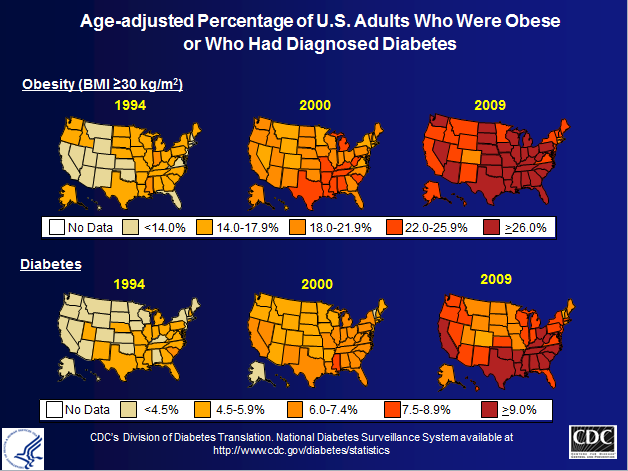
CDC map showing the rising rates of obesity and diabetes since 1994
Those of you who read my last report on obesity know the Centers for Disease Control and Prevention (CDC) has a map showing the increase in obesity rates on a state-by-state basis since 1985. They also have a similar map related to diabetes rates. I have included the link here and suggest it is very worthwhile to review. The set of slides is a comparison of diabetes and obesity trends, but they have only correlated these statistics beginning with 1994. It would have been more enlightening to view the comparison of statistics beginning with 1985.
What is very interesting is the high correlation between obesity and diabetes trends. It is important to understand that almost all obesity-related diabetes (“diabesity”) is considered type 2. Most doctors’ first line of therapy will be diet and exercise. If diet and exercise does not work for the patient, doctors will add oral medications to increase the amount of insulin being produced or medications to increase the receptors’ ability to absorb glucose. In many instances they will use both.
More Sleep May Mean Less Cravings

Getting adequate sleep correlated with less binge eating episodes in women, according to new study
Not getting enough sleep may bring about binge eating in women, a new study finds.
Researchers from the University of North Carolina suggest that women lacking restful sleep are more likely to report binge eating, irrespective of weight, age, current relationship status, and depression.
Binge eating is viewed as a loss of control that results in large intakes of food during a short period of time. As much as a quarter of U.S. adults battling obesity have reported a history of binge eating.
“Over the past half-century, there has been a steady and rapid decline in time spent sleeping, which has paralleled the rapid rise in the prevalence of overweight and obesity,” the authors wrote. Continue reading
Too Little DHA May Shrink Your Brain

Higher intake of fish oil could slow brain aging, according to new research.
It’s normal for the human brain to get smaller with age. But too little of the omega-3 fatty acid docosahexaenoic acid (DHA) may shrink brains more quickly and cause thinking problems, research from the University of California, Los Angeles (UCLA) suggests.
This new cross-sectional study, published in the journalNeurology, has now found that lower levels of red-blood cell DHA levels are associated with smaller brain volumes, as well as vascular-related problems with learning and memory. Continue reading

No comments:
Post a Comment