Thursday, April 19, 2012


“Diabesity” Rates Soaring in the U.S.

By Dennis Harper, DO, Isagenix Scientific Advisory Board Chair
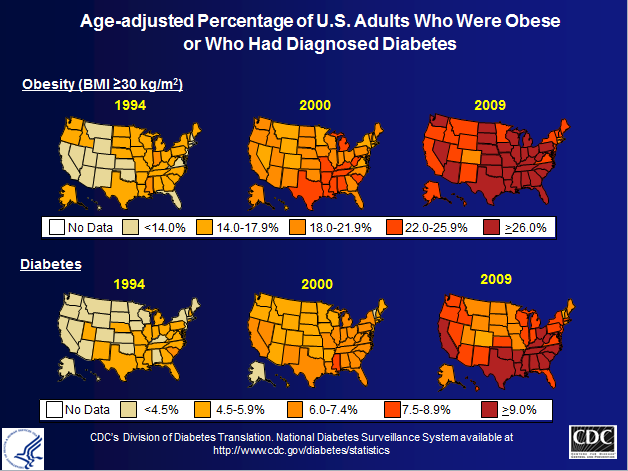
CDC map showing the rising rates of obesity and diabetes since 1994
Those of you who read my last report on obesity know the Centers for Disease Control and Prevention (CDC) has a map showing the increase in obesity rates on a state-by-state basis since 1985. They also have a similar map related to diabetes rates. I have included the link here and suggest it is very worthwhile to review. The set of slides is a comparison of diabetes and obesity trends, but they have only correlated these statistics beginning with 1994. It would have been more enlightening to view the comparison of statistics beginning with 1985.
What is very interesting is the high correlation between obesity and diabetes trends. It is important to understand that almost all obesity-related diabetes (“diabesity”) is considered type 2. Most doctors’ first line of therapy will be diet and exercise. If diet and exercise does not work for the patient, doctors will add oral medications to increase the amount of insulin being produced or medications to increase the receptors’ ability to absorb glucose. In many instances they will use both.

More Sleep May Mean Less Cravings

Getting adequate sleep correlated with less binge eating episodes in women, according to new study
Not getting enough sleep may bring about binge eating in women, a new study finds.
Researchers from the University of North Carolina suggest that women lacking restful sleep are more likely to report binge eating, irrespective of weight, age, current relationship status, and depression.
Binge eating is viewed as a loss of control that results in large intakes of food during a short period of time. As much as a quarter of U.S. adults battling obesity have reported a history of binge eating.
“Over the past half-century, there has been a steady and rapid decline in time spent sleeping, which has paralleled the rapid rise in the prevalence of overweight and obesity,” the authors wrote. Continue reading →

Too Little DHA May Shrink Your Brain

Higher intake of fish oil could slow brain aging, according to new research.
It’s normal for the human brain to get smaller with age. But too little of the omega-3 fatty acid docosahexaenoic acid (DHA) may shrink brains more quickly and cause thinking problems, research from the University of California, Los Angeles (UCLA) suggests.
This new cross-sectional study, published in the journalNeurology, has now found that lower levels of red-blood cell DHA levels are associated with smaller brain volumes, as well as vascular-related problems with learning and memory. Continue reading →

The Role of Muscle in Weight Loss

Trainer: Dr. Michael Colgan
With so many people who would like to lose weight, there is a great need for health professionals to properly guide these people through the process. Dr. Michael Colgan, world-renowned research scientist, has provided nutrition and training programs for thousands of people, and is director of his eponymous Colgan Institute, a consulting, educational and research facility concerned with the effects of nutrition and exercise on athletic performance, along with prevention of chronic degenerative disease, and prevention of degeneration of the brain. Listen in as he discusses the importance of retaining lean muscle mass while losing weight, and why muscle just might hold the secret to successful and healthy weight loss for anyone embarking on the journey.
 

Low-Glycemic Diet Improves Inflammatory Profile in Overweight and Obese

Eating low-glycemic foods such as whole grains and fiber-rich fruits may reduce markers of inflammation in overweight and obese people, according to new study
Results of a new study suggests that a low-glycemic diet — rich in foods containing carbohydrates that are slowly absorbed into the bloodstream — significantly lowered markers of inflammation and also increased a hormone that helps in regulating the metabolism of sugar and fat.
The study, which be published in the February issue of the Journal of Nutrition, randomized 80 healthy men and women to a controlled feeding trial. Half of the participants were normal weight and half were overweight or obese.
The researchers, from the Fred Hutchinson Cancer Research Center in Seattle, found through subjects’ blood samples that C-reactive protein, a biomarker of inflammation, was reduced by about 22 percent among the overweight and obese subjects who followed the low-glycemic diet.
“This finding is important and clinically useful since C-reactive protein is associated with an increased risk for many cancers as well as cardiovascular disease,” said lead author Marian Neuhouser, Ph.D., R.D. “Showing that a low-glycemic-load diet can improve health is important for the millions of Americans who are overweight or obese.” Continue reading →


http://mdbarnhill.isagenix.com/us/en/retire_wealthy.dhtml

Could Routine Cleanse Days Help You Live Longer?


New research suggests intermittent fasting may reduce risk of cardiovascular disease and type 2 diabetes.
One of the unique parts of an Isagenix system is its Cleanse Days. As anyone who uses Isagenix products knows well, performing routine Cleanse Days are at the heart of gaining the greatest health benefits. This is because Cleanse Days help “reset” cellular mechanisms in the body, sparking fat burning, detoxification, and a host of other positive effects.
A major characteristic of Cleanse Days—apart from supplementation with Cleanse for Life, the detox-promoting drink—is the abstinence from food, or intermittent water fasting. Now, evidence is growing that intermittent water fasting could be key to avoiding chronic diseases such as cardiovascular disease and type 2 diabetes.
While most people are aware of the strong evidence behind calorie restriction (as achieved on Shake Days) for reducing risk of chronic disease, recent studies are finding that it may be intermittent fasting (as on Cleanse Days) that is even more beneficial for ultimate longevity. 
Previously, Dr. Benjamin Horne and colleagues at Intermountain Heart Institute in Salt Lake City found an association between periodic (or intermittent) fasting and reduced risk of cardiovascular disease. The same research team has recently further extended their analysis and found an association with reduced risk of type 2 diabetes (diabetes mellitus), which is characterized by uncontrolled blood sugar.
The scientists pooled data from 648 patients undergoing an angioplasty procedure and found that risk of diabetes was lower in individuals that undergo routine, periodic fasting. Periodic fasting was not only linked to lower rates of diabetes and cardiovascular disease, but it was also linked to a lower fasting blood sugar level in individuals who did not have diabetes. The individuals pooled in the current study are reported to fast for 24 hours a month.
Not observed in previous studies, the authors reported that periodic fasting was also associated with a lower body mass index (BMI), a ratio based on an individual’s height and weight used as criteria for determining overweight and obesity.
The researchers pose a variety of mechanisms that may underlie the protective benefits that fasting provides:
  • Reduced levels of chronic oxidative stress and inflammation, which are potential factors in insulin resistance and eventual type 2 diabetes.
  • A “reset” of cellular sensitivity to glucose and/or insulin.
  • Increased levels of human growth hormone (HGH). In an earlier study, the researchers found that fasting for 24 hours increased HGH by 20 times in men and 13 times in women. The surge of HGH stimulates fat burning as it prevents muscle breakdown.
While the benefits of intermittent water fasting are promising, undergoing a prolonged fast (longer than two days) is not recommended. Prolonged fasting can bump the body into a state of starvation potentially causing loss of muscle and harming the body’s health.
Notably, the majority of subjects included in Dr. Horne’s research are members of the Church of Jesus Christ of Latter-Day Saints (LDS). This population is ideal because many undergo monthly fasting as part of their religious practice. Of the patients pooled, 34 percent reported participating in routine monthly fasting.
LDS members are generally at a lower risk for several chronic diseases due to a cluster of preventative behaviors including abstinence from smoking and alcohol. Each of these behaviors had to be considered in the study. The association between periodic fasting and lower risk of diabetes and cardiovascular disease remained significant after controlling for age, gender, and lifestyle behaviors.
Cleanse Days, as advocated by Isagenix, provide the health benefits of intermittent water fasting while also including Cleanse for Life, a supplement that comes with the added advantage of optimal dosages of vitamins, minerals, and actives from botanicals. These assist the body’s detoxification and cleansing processes.
When Cleanse Days are performed regularly (one or two days a week, or one day every other week), the body undergoes a variety of positive changes. There are various enzymes that are activated, mitochondria are shown to increase in number and become more efficient, oxidative stress is reduced (a hallmark of longevity), and fat is mobilized and used for fuel in the muscle and liver. Cleanse for Life also revs up detoxification and antioxidant enzymes for cellular health.
The positive biological changes created on Cleanse Days are enhanced when followed by Shake Days—rich in quality protein, good fats, low-glycemic carbohydrates, vitamins and minerals. They lead to decreases in body fat (especially visceral fat), reduced levels of oxidative stress and inflammation, increased insulin sensitivity, and better maintenance of muscle. These are biochemical changes that lead to reduced risk of chronic disease and better health long-term.
References
Horne BD et al. Relation of Routine, Periodic Fasting to Risk of Diabetes Mellitus, and Coronary Artery Disease in Patients Undergoing Coronary Angiography. Am J Cardiol. 2012;xx:xxx. doi: 10.1016/j.amjcard.2012.01.379.
Horne BD, et al. Usefulness of routine periodic fasting to lower risk of coronary artery disease among patients undergoing coronary angiography. Am J Cardiol. 2008. doi:10.1016/j.amjcard.2008.05.021